Toronto Shootings: Iranian Finance Linked to Dozen Attacks
Police and court records suggest a foreign government paid for early morning attacks on synagogues and the U.S. Consulate in 2026.
By Adrian Carter ·
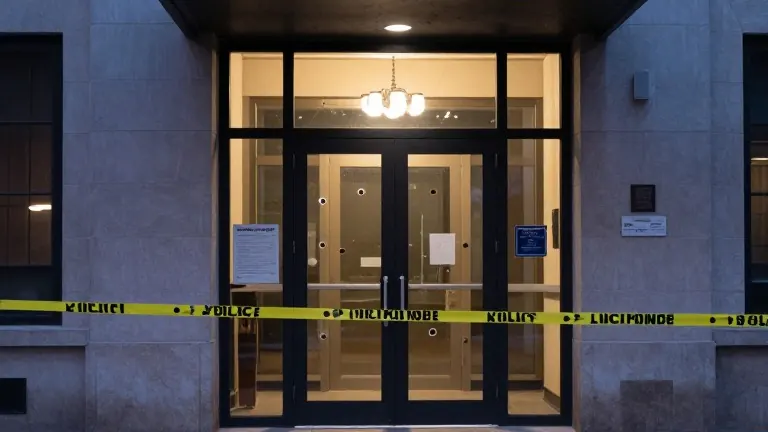
Residents of the Greater Toronto Area woke to the sound of gunfire in early 2026, finding bullet holes in the doors of synagogues and the entrance to the U.S. Consulate. No one was injured in the dozen politically motivated shootings, but the pattern of violence points to a specific source of funding: the Iranian government.
The attacks occurred in the hours and days after the United States and Israel began bombing Iran on February 28. The U.S. and Israeli campaign included the assassination of Iran’s Supreme Leader, Ayatollah Ali Khamenei. The shootings targeted Jewish institutions, a school, businesses, and the American diplomatic mission downtown.
The incidents followed a consistent method known as gun-for-hire violence. Suspects arrived in stolen cars during the early morning hours. They emptied handguns into building entranceways while filming the acts on phones. This model uses encrypted apps and intermediaries to create distance between the client and the criminal.
Chief Superintendent Joe Matthews, who oversees the Toronto Police Service investigation, stated that the department is examining every angle of the foreign actor involvement. He noted that while the financier and the perpetrator on the street are not directly connected, the evidence suggests a coordinated effort.
Court files indicate that many of the accused are young, ranging in age from 15 to their early 20s. Most face charges for multiple attacks. Ballistic tests confirmed that the same firearms were used in shootings targeting both political entities and non-political businesses. Specifically, attacks on synagogues and Jewish-owned businesses occurred near addresses associated with waste management company Green For Life, or GFL.
Matthews explained that the crossover in ballistic evidence points to the same hired guns carrying out both types of attacks. The RCMP and the Canadian Security Intelligence Service are also investigating whether a foreign power instigated the series of events.
The Iranian government has been linked to similar plots in Germany, the Netherlands, the U.K., Australia, and the United States. In May, the FBI arrested Mohammad Baqer al-Saadi in New York. He is alleged to be a senior member of Harakat Ashab al-Yamin al-Islamiya, a militia controlled by Iran’s Revolutionary Guard. The indictment claims he helped coordinate at least 18 attacks in Europe and two in Canada, including the March 2026 shooting at the U.S. Consulate and an assault on a synagogue.
In June, Canada joined 20 other nations in a joint statement condemning Iran’s lethal plotting in Europe, North America, and Australia. The statement described the relationship between Iranian security services and local criminal groups as long-standing. Security analyst Keir Giles of Chatham House noted that Iran is using a blueprint similar to the one Russia employed in Europe after its invasion of Ukraine.
Giles said that encrypted communication apps have made it easier for state actors to recruit individuals at low cost. The Iranian Foreign Ministry did not respond to requests for comment regarding the Toronto attacks, consistent with its past dismissal of claims that it sponsors violence abroad.
Rabbi Daniel Korobkin of Beth Avraham Yoseph of Toronto synagogue addressed the congregation after a bullet-riddled attack in March. He said the community refuses to be intimidated by players who make Jews the pariah of the story. Korobkin noted that it does not matter whether the person who hates them is pulling the trigger or paying someone else to do it.