Frankfurt Stores Looted as European Youth Protests Spread
Tens of thousands demonstrated in Germany and other European nations on Saturday, demanding lower living costs and opposing mandatory military service.
By Ama Ndlovu ·
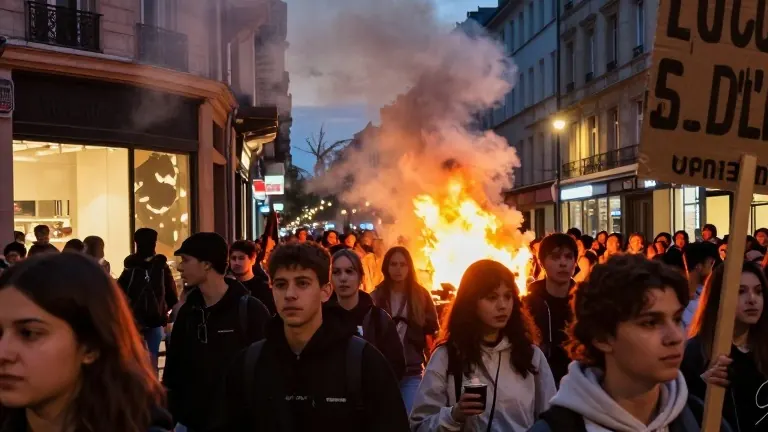
Tens of thousands of young people across Europe took to the streets on Saturday to protest living costs and social policy. The demonstrations were organized by the campaign group Gen Z Regelt and spanned more than 30 cities in Germany. Frankfurt and Berlin hosted some of the largest gatherings, where crowds demanded better education, climate protection, and housing. The group also opposed plans to reintroduce mandatory military service. While many areas remained peaceful, violence broke out in several urban centers.
In Frankfurt, rioters looted stores and set fires to barricades in the city center. Frankfurt police reported that windows were smashed at multiple shops and that Molotov cocktails were thrown at emergency services. Authorities urged bystanders to leave the area or avoid the city center entirely. In Hamburg, protesters set barricades on fire, and some businesses had boarded up their entrances in anticipation of the unrest.
Lina Friedrich, a spokesperson for Gen Z Regelt, stated in Berlin that the group sought to fight for peace and freedom rather than war and coercion. She emphasized the need for better support for health and education systems. Friedrich added that the group opposed compulsory military service and favored a fairer distribution of the burden. Organizers initially expected 182,000 participants, but official numbers reported in the afternoon indicated a lower turnout.
These German protests occurred alongside similar demonstrations in France, Italy, Spain, and Serbia. In France, student protests regarding education last month evolved into wider demonstrations about the cost of living and social security. France’s Interior Ministry reported a turnout of 320,000 on Saturday. In Paris, protesters held a banner reading, “We do not need tear gas for our future to be blurry.” Videos reviewed by NBC News showed large crowds and fires burning in Marseille.
Roman Poseck, the interior minister for the German state of Hesse, warned against using the recent unrest in France as a model. He cited images of looting and burning police vehicles, stating that France should not be held up as an example in this regard. In Italy, Prime Minister Giorgia Meloni’s government deployed 500 army troops alongside police in Milan until the end of the year. This decision followed incidents earlier in the month where masked groups looted stores and threw projectiles at police.
Demonstrations in Rome were largely peaceful, though police used water cannons and charged to disperse groups of protesters. In Serbia, student-led activism recently helped unseat the country’s long-time leader at the ballot box. In Portugal, police forcibly cleared a tent camp in Lisbon early Sunday that activists had set up to protest high housing costs. Hundreds of protesters were dispersed using shields and baton charges, according to the Reuters news agency.
Andrew Barclay, a politics lecturer at the University of Sheffield, noted that the French protests involved hundreds of thousands of people over many weeks. He said those demonstrations initially centered on specific grievances about education funding. Barclay observed that protests elsewhere had a broader range of complaints but smaller scale. He cautioned against comparing these movements to Serbia, where protests directly challenged state corruption and led to governance changes.
Barclay stated that protests in Germany and France were unlikely to lead to direct changes in governance. He explained that large protests often do not capture the same level of support across a country as those in Serbia. He advised being cautious when comparing the organized opposition to state corruption seen in Serbia to the broader social protests occurring elsewhere in Europe.