Shi'ite Poll Signals Major Shift in Lebanese Security Strategy
A new survey indicates that a majority of Lebanon's Shi'ite community now favors state control of weapons, challenging Hezbollah's long-standing monopoly on defense.
By Ama Ndlovu ·
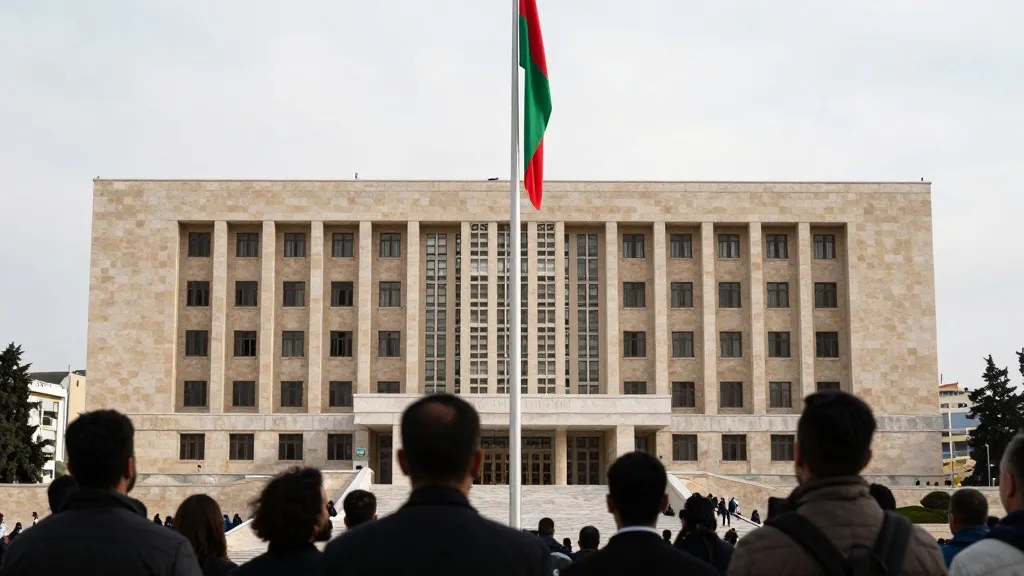
Recent polling data suggests a fundamental change in how Lebanon's Shi'ite community views national security. The latest findings, released in mid-October, show that the group that has traditionally formed the core of Hezbollah's support is increasingly open to the idea that the state should hold the monopoly on force. This development marks a significant departure from the group's historical position that its arsenal is the primary shield against Israeli aggression.
The survey was conducted in September by Statistics Lebanon and polled 800 Shi'ite respondents. The results are striking. A clear majority, 66.4%, supported handing Hezbollah's weapons over to the Lebanese state, while only 29.6% preferred the group to retain them. The shift is even more pronounced regarding the decision-making process for conflict. Seventy-one percent of respondents believed that choices regarding war and peace should rest exclusively with the Lebanese state. Only a small fraction, 5.9%, wanted Hezbollah leadership to play a larger role in shaping the country's future.
Trust in the national military appears to be rising, challenging the group's claim to be the sole guardian of Shi'ite interests. Roughly 78.5% of those surveyed expressed confidence in the Lebanese Armed Forces. More than half, 51.1%, identified the army as the institution best suited to guarantee long-term security, compared to just 16.5% who selected Hezbollah. These figures suggest that the traditional narrative of the militia as the essential security provider is losing ground among its own base.
However, the sentiment is not uniformly critical. The data reveals a complex mix of disappointment and lingering loyalty. Approximately 67.4% felt that Hezbollah had failed to achieve its goals or had only partially succeeded in the war with Israel. Over 42% expressed anger or concern about the leadership's handling of the conflict. Despite this, nearly 60% still maintained some level of trust in the organization. Roi Kais, a reporter for Israel's public broadcaster KAN, noted that the social support networks and status Hezbollah provides continue to sustain its influence, particularly as long as no other entity fills the resulting vacuum.
The current findings stand in sharp contrast to earlier data. A May 2026 survey cited by researchers Orna Mizrahi and Moran Levanoni at Israel's Institute for National Security Studies found that 87.5% of Shi'ite respondents opposed disarming Hezbollah. Mizrahi and Levanoni argued that the group's power rests on deep social and economic ties, political authority, and the historical marginalization of the sect. They suggested that weakening Hezbollah would require a stronger army and financial support from Western and Gulf nations to allow the state to replace the services the militia provides.
Local signs of wariness are also emerging. In the southern city of Tyre, property owners reportedly resisted opening a branch of Al-Qard Al-Hassan, a financial institution linked to Hezbollah, fearing it might become a target in Israeli strikes. Such branches have been hit in the past. Meanwhile, the group has announced aid of up to $14,000 for families in Beirut and its southern suburbs whose homes were destroyed, and up to $12,000 for those elsewhere. With major leadership losses including the 2024 killing of Hassan Nasrallah and heavy destruction from a war that began in March 2026, the future of this discontent will depend on whether the state can deliver security and economic stability.