Grossi's UN bid faces hurdles from geopolitical rivals and gender parity push
IAEA chief Rafael Grossi faces a tough path to the UN secretary general role amid geopolitical tensions and a strong push for female leadership.
By Adrian Carter ·
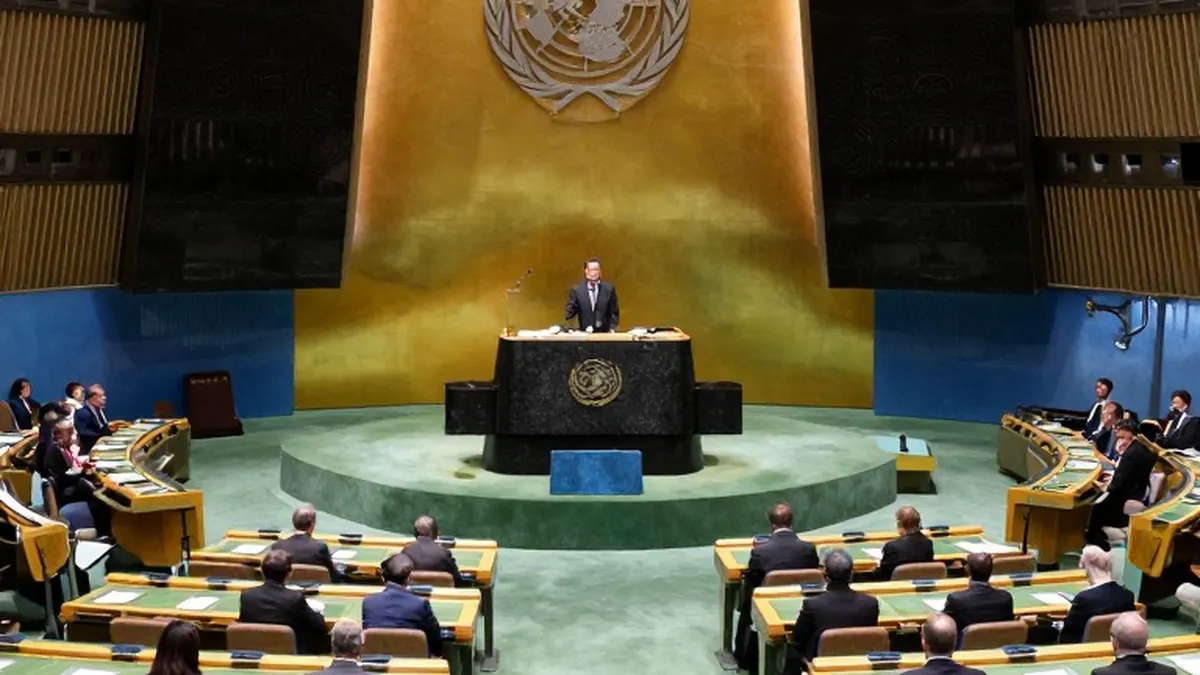
Rafael Grossi, the current director general of the International Atomic Energy Agency, is positioning himself for the role of United Nations secretary general as the search to replace Antonio Guterres intensifies. In the most recent Security Council straw poll, the Argentinian diplomat placed second behind Costa Rica’s Rebeca Grynspan. Grossi received nine votes encouraging his candidacy and four discouraging votes, with eight other candidates still in the running.
At 65, Grossi has built a reputation for a hands on approach to crisis diplomacy. Since taking the helm of the nuclear watchdog in 2019, he has been a visible figure in international conflicts. Following Russia’s full scale invasion of Ukraine in 2022, he personally led inspection teams to the Zaporizhzhia and Chornobyl nuclear power plants. Jan Wouters, a professor at KU Leuven, noted that Grossi transformed the agency into a proactive diplomatic actor by engaging directly with world leaders.
In Ukraine, Grossi focused on technical safety rather than territorial sovereignty. This approach helped broker eight localised ceasefires between Russia and Ukraine to allow for critical repairs at the plants. However, his active role has not been universally welcomed. Ezequiel Jimenez Martinez, a law professor in Barcelona, observed that Russia, which holds veto power in the Security Council, views Grossi as having overstepped his mandate.
To win the position, a candidate needs at least nine affirmative votes from the 15 member Security Council and must avoid a veto from any of the five permanent members. The United Nations General Assembly then gives final approval. With Guterres set to leave his post on December 31, the race is becoming increasingly tight. Analysts suggest that China and Russia may struggle to support a candidate who is closely aligned with the United States.
Reports indicate that Beijing has ruled out Grossi, preferring Grynspan. Iran has also voiced opposition, with its foreign ministry accusing the IAEA of biased reporting on its peaceful nuclear programme. The agency estimated that Iran held 440.9 kilograms of uranium enriched to 60 percent before the June 2025 attacks on its nuclear facilities. Despite this, Jimenez Martinez believes Grossi will withstand the criticism because most agency governors agree with his approach.
A significant challenge for Grossi is his close alignment with Argentinian President Javier Milei and US President Donald Trump. Milei has described the UN as useless and its diplomats as arrogant parasites. The Trump administration has also criticized the UN, withdrawing from key agencies and reducing funding. Observers argue that Grossi’s agenda, which focuses on reform and cutting red tape, may be seen as shrinking the UN structure.
Alvina Hoffmann, a lecturer at SOAS University of London, pointed out that Grossi emphasizes improving systems and cutting overlapping mandates rather than addressing structural inequality. His style favors confidential negotiations over public condemnations, which could be a downside in an era where international law is under attack. His insistence on cutting bureaucracy without detailed safeguards may also face resistance in the General Assembly.
The selection process is also shaped by the tradition of geographical rotation, which suggests the next secretary general should be from Latin America. Five women are currently in the race, and there is intense pressure from civil society groups to elect the first woman to lead the UN in its 81 year history. Rebeca Grynspan, who leads the race, fits both the geographical and gender criteria.
Ben Donaldson of the 1 for 8 Billion campaign argued that merit and gender considerations are not mutually exclusive. He noted that UN resolutions call for gender balance in senior leadership. Donaldson emphasized that the UN has existed for 80 years without a female secretary general, a fact that contrasts with the organization’s own commitments to equality and nondiscrimination.
As the final decision approaches, Grossi must navigate these complex geopolitical and social dynamics. His ability to balance his reformist agenda with the diverse expectations of the UN membership will determine whether he can secure the necessary support to become the next head of the United Nations.