Thames Wreck Loses Masts, 1,500 Tons of Bombs Remain
Crews removed the SS Richard Montgomery's three masts for under $13 million, eliminating a collapse risk while leaving the WWII cargo undisturbed on the seabed.
By Adrian Carter ·
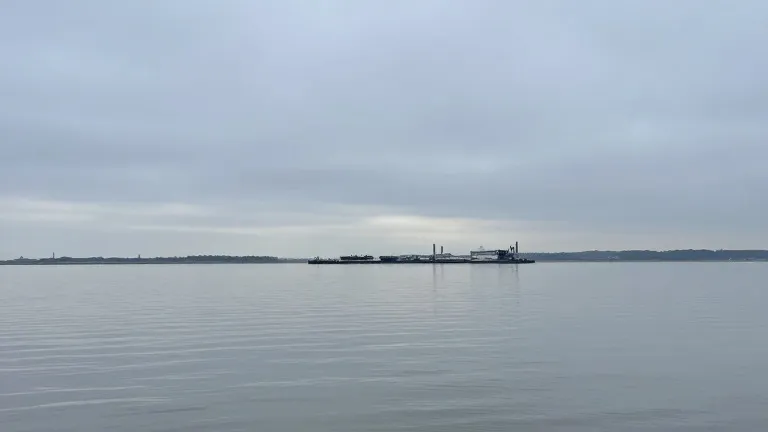
For decades, the three rusting masts of the SS Richard Montgomery punctuated the horizon of the Thames Estuary. They were a fixed landmark for local residents and a visual cue for the thousands of vessels passing through one of the world's busiest waterways. As of this week, those masts are gone. They have been cut, lifted, and transported to a museum, removing a persistent structural hazard from a ship that still sits on the seabed with its cargo of explosives.
The removal of the masts addresses a specific engineering concern rather than solving the entire problem. Nolan Conway, a naval architect with Resolve Marine Group, explained that the vessel had begun to lean. He noted that the primary fear was that the masts could fall onto the cargo below, triggering a detonation. Some of the munitions are believed to have pressure fuses, meaning a physical impact could set them off. By removing the overhead structures, the team eliminated that direct threat.
The operation cost just under $13 million and was completed ahead of schedule. U.K. maritime minister Keir Mather told the House of Commons that the project was finished on budget. He stated that the masts had placed a significant load on the wreck's structure, and their removal reduces that risk. Mather emphasized that the work supports the long-term safe management of the site, which remains a critical part of the Thames shipping route.
The technical execution required avoiding any vibration or movement that could disturb the sediment or the cargo. Conway described the use of a custom lifting frame designed to raise each mast vertically without swinging. To cut the masts at the waterline, the team used a remotely operated underwater diamond-wire saw. This device clamps around the mast with hydraulic arms and passes the saw through the metal, allowing the work to be done without divers entering the water.
The SS Richard Montgomery is one of approximately 2,700 ships built in the United States to support the Allied war effort. It ran aground on a sandbar off Sheerness in August 1944, roughly 40 miles from London. The ship was carrying munitions intended for use after the D-Day landings. It broke apart during salvage attempts and sank, leaving an estimated 1,500 tons of explosives in its holds.
Those explosives have not been touched. Experts disagree on the potential consequences of a detonation. Conway said estimates range from localized damage to the shoreline to a tidal wave traveling up the Thames. Other scenarios suggest a minor event that might only close a nearby shipping channel. He summarized the uncertainty by saying there is a large range of impacts, but none of them are really good. Officials still judge the overall chance of an explosion to be low.
The government has maintained an exclusion zone around the wreck for years. The site lies about 1.5 miles off the Sheerness coast. Mather confirmed that the area will continue to be subject to continuous monitoring and control. The masts are not being scrapped; they have been moved to the Historic Dockyard Chatham museum. There, they will be displayed to recognize the ship's role in the war.
The Montgomery will remain where it came to rest. More than eighty years after it failed to reach Europe, the ship and its cargo stay entirely out of sight. The removal of the masts changes the visual profile of the estuary but leaves the underlying historical and logistical reality intact. The wreck remains a managed risk in a critical shipping lane, monitored by experts who keep watch over the silent cargo below.
More Business · World news · Business Watchdog · Report a business · Got a Story?